

NET ZERO MEETS REALITY.
WHEN ENERGY DREAMS COLLIDE WITH INDUSTRIAL FACTS.

A country promised a green future. Reality arrived instead. Factories need power. Ships need fuel. Ideals collapsed quickly. Energy physics does not negotiate with policy ambitions.
Net zero sounded noble. Then the lights flickered. Governments discovered something obvious. Modern economies run on dense, reliable energy. Wishful thinking is not a fuel source.
Time is running out.
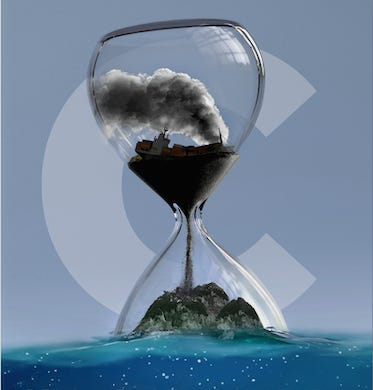
Just a few months ago, South Korea was congratulating itself. Targets were announced. Speeches were delivered. Numbers were impressive. A planned reduction of 53 to 61 percent in greenhouse gas emissions from 2018 levels by 2035 was presented as a triumph of modern thinking.
It sounded serious. It sounded responsible. It sounded like the sort of thing that earns applause at international conferences where nobody has to keep the lights on.
Fast forward to April 2026 and the tone has changed. The same government is now scouring global markets for oil and natural gas, asking Gulf producers for steady supply and safety guarantees for shipping. The contrast is not subtle. It is the difference between a TED Talk and a power outage.
This is not a minor adjustment. It is a full reversal.
The anti fossil fuel lobby had celebrated South Korea as proof that a major industrial economy could detach itself from hydrocarbons. Fossil fuels were described as relics, poisons, leftovers from a primitive past. It all sounded very enlightened.
Now those same fuels are being treated as lifelines.
The shift is not confined to policy papers. It has reached the street level. On April 1, the government raised its energy security alert and introduced strict conservation measures. Public sector fleets, about 1.5 million vehicles across ministries, schools, and local governments, were told to drive on alternating days depending on licence plates.
This is not what victory looks like.
At the same time, the leadership has begun praising stable supplies of liquefied natural gas and coal from Indonesia as reassuring. That word matters. Reassuring is what people say when they realise the thing they were trying to eliminate is the thing keeping everything running.
So what happened.
The answer is not political. It is physical.
Wind turbines and solar panels have their uses. They can generate electricity when conditions are right. What they cannot do is replace the continuous, high density energy required to sustain an industrial economy.
South Korea is not a small, sleepy place. It is one of the most advanced manufacturing economies on Earth. Its refineries process millions of barrels of oil every day. Facilities in Ulsan, Yeosu, and Onsan are among the largest globally.
These are not decorative installations. They produce fuels and feedstocks that underpin entire industries.
Take naphtha. It comes from oil refining. It feeds petrochemical plants that produce ethylene and propylene. South Korea is the fourth largest producer of these chemicals in the world. Without them, there are no plastics, no synthetic fibres, no resins.
Remove those and entire sectors vanish. Automobile manufacturing, electronics, textiles, packaging, medical supplies, construction materials. The modern world is not powered by electricity alone. It is built from hydrocarbons.
Oil does not just move goods. It makes them possible.
South Korea imports more than 97 percent of its energy. That is not a policy choice. That is geography. Crude oil and natural gas make up the majority of that supply.
When a country like that decides to pursue aggressive net zero targets, it is making a promise that must compete with reality. Reality usually wins.
Instead of focusing on securing diversified oil and gas supplies and expanding LNG partnerships, policy shifted toward targets that look impressive on paper but struggle in practice.
This is not unique to South Korea. It is a pattern.
Climate policies are often presented as moral imperatives. They are framed in absolute terms. The language is urgent. The tone is uncompromising.
But when those policies meet the practical demands of running a modern economy, compromises appear very quickly.
The science behind catastrophic predictions remains debated. The historical record shows periods of warming that coincided with increased agricultural productivity and broader environmental greening. Higher atmospheric CO₂ has been associated with improved plant growth and food production.
None of this fits neatly into a narrative of impending collapse.
I am from The Left and I care about the planet and the vulnerable. That is precisely why this matters. When energy policy fails, it is not politicians or activists who suffer first. It is ordinary people. Higher costs. Job losses. Reduced stability. The vulnerable do not experience ideology. They experience consequences.
South Korea’s rise from post war devastation to global economic powerhouse was not powered by slogans. It was powered by reliable, energy dense fuels that enabled industry, trade, and innovation.
Turning away from that foundation without a viable replacement is not bold. It is risky.
The recent scramble for oil and gas is not a failure of ambition. It is a reminder of limits.
Physics does not care about targets. Chemistry does not respond to speeches. Energy systems operate according to rules that cannot be negotiated.
This does not mean change is impossible. It means change must be grounded in reality.
A country that depends on imported energy must prioritise security. It must ensure supply. It must recognise the role hydrocarbons play not just in electricity generation but in the entire industrial ecosystem.
The idea that wind, solar, and batteries alone can sustain a complex manufacturing base remains unproven at scale.
South Korea has learned this lesson the hard way. Others would be wise to pay attention.
Because the real world has a habit of interrupting good intentions.
And when it does, the bill arrives immediately.
Got thoughts? Outrage? Sarcasm? Drop a comment below.
Share this with friends, if you like it — or with your enemies, if you don’t!
Subscribe for free. It’s cheaper than therapy — and marginally less disturbing.
South Korea promised deep emissions cuts but quickly returned to fossil fuels. Energy demand exposed limits of renewables. Industry depends on hydrocarbons. Policy collided with physics. Economic stability requires reliable energy. The lesson is simple. Ambition must match reality.
Energy literacy is very low among the people pushing nut zero policies and dependency on solar/wind/batteries. A few weeks without the modern products you describe or unreliable on demand electricity would help end energy illiteracy quickly. Oh, the unrest of a society would be enormous.
I live in Canada, a sparsely populated country with one of the coldest climates on earth. oil&gas is critical to our ability travel large distances, exploit our bountiful resources, and get our products to market not to mention simple survival during the winter months even in urban areas. Without it 90% of our landmass would be effectively uninhabitable. Scary predictions of warming associated with CO2 emissions are derived from IPCC models and the validity of those models are heavily disputed. Even if one uses the standard IPCC model, the curtailed warming from Canada achieving net-zero by 2050 is roughly 0.02°C by end century. None of these facts are disputed they're just ignored. I will never understand how any Canadian government could commit to net-zero and having done so, not be heavily criticized in the media. It's an interesting time we live in.